During our last NomadMania Conference in Ouro Preto, Brazil, the community made an important decision: to transition from UN+ to ATLAS. The purpose of this move is to create an additional travel list developed by the NomadMania community — one that goes beyond countries and adds value from both a traveller’s perspective and a broader understanding of the world.
The name ATLAS was suggested during the conference by Daniel Railey and subsequently approved by a vote of the delegates. It stands for Additional Territories, Lands and States.
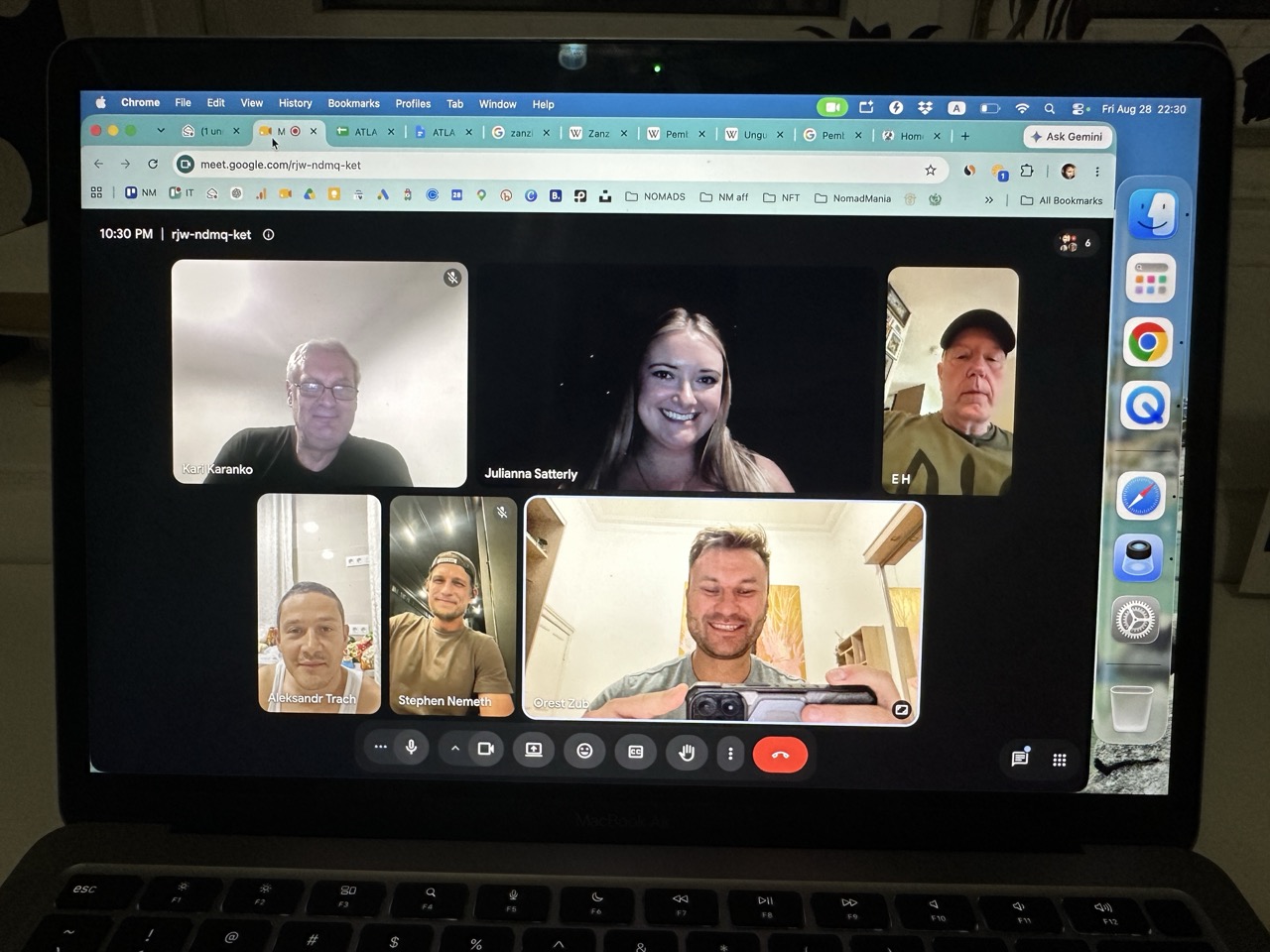
It was also decided to establish a dedicated committee to develop the list and define the principles behind it. The members of the ATLAS Committee are: Stephen Nemeth, Julianna Satterly, Darren McLean, Kari Karanko, Ed Hotchkiss, Alex Trach and Pablo Gutierrez.
Under the strong leadership of Stephen Nemeth and Julianna Satterly, the committee has done an amazing job developing the framework and has now come up with the following result:
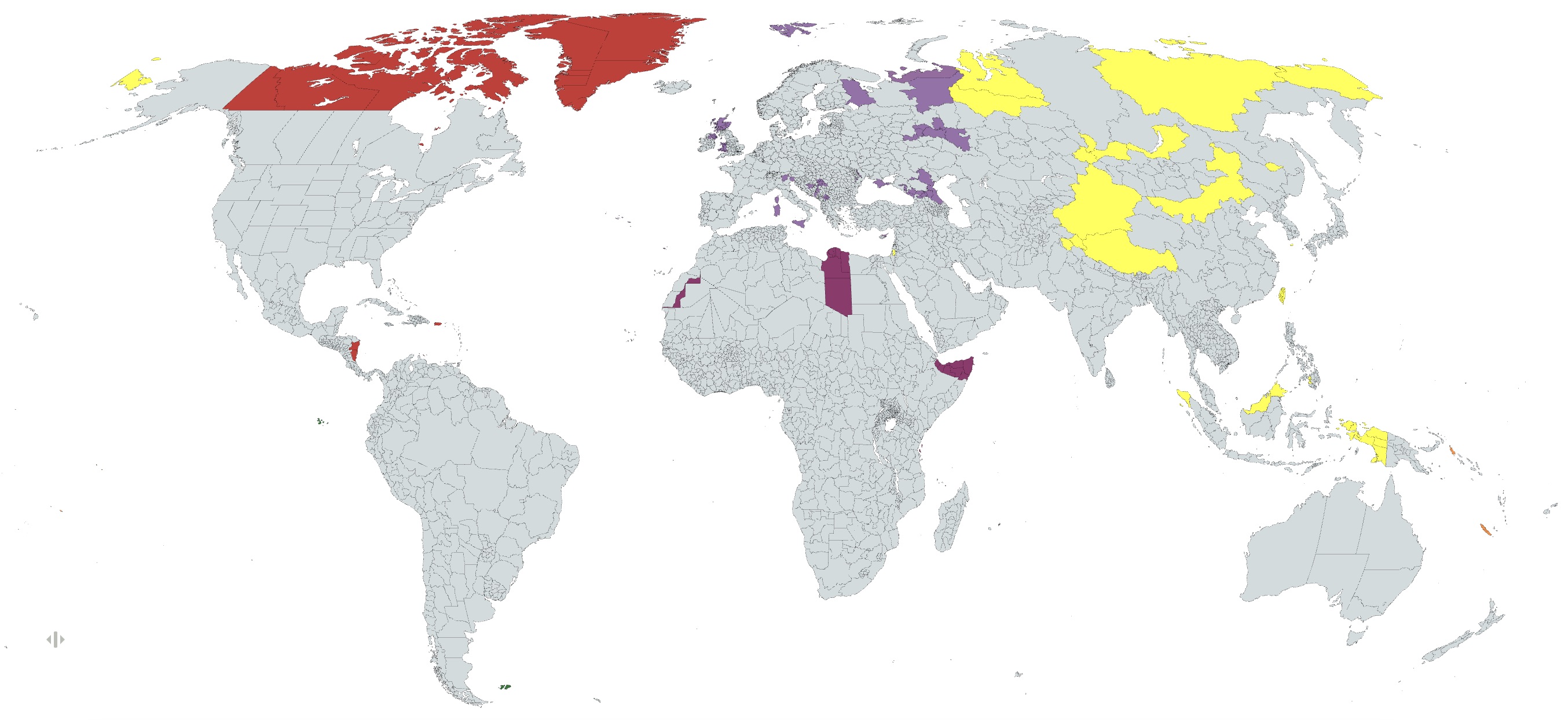

The ATLAS list identifies subnational states and territories that possess a sufficiently distinct political, administrative, legal, or territorial status to be treated as separate travel goals from the country in which they are located.
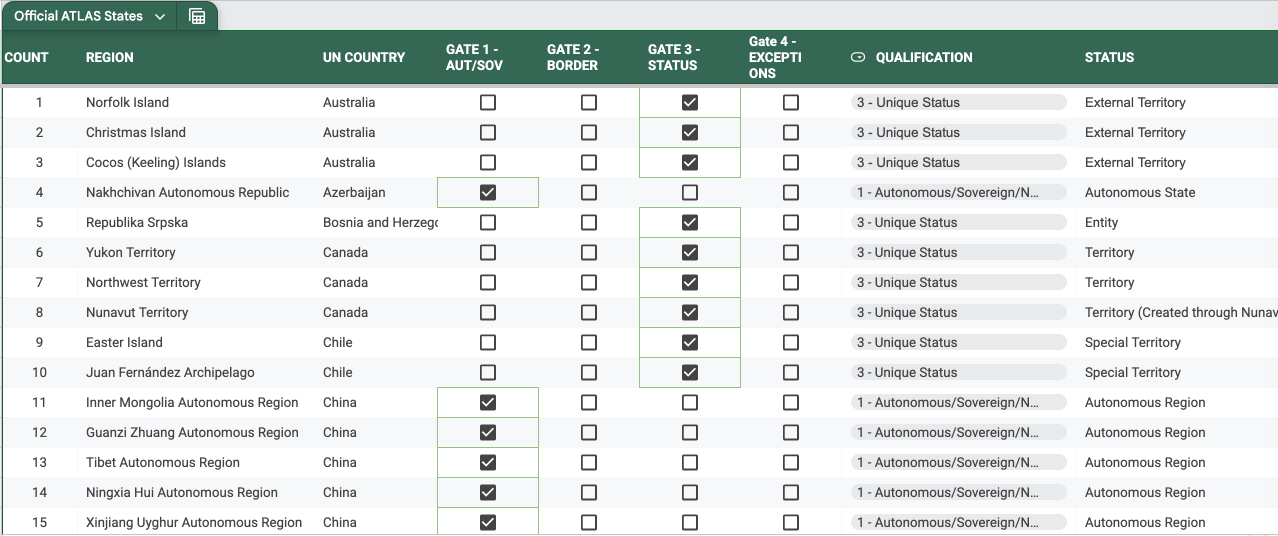
To be included in the ATLAS list, an entity must first satisfy all four Hard Requirements. It must then satisfy at least one of the four Inclusion Gates, subject to the principles and exceptions described below.
I. Hard Requirements
Hard Requirement 1 — Civilian Population
An ATLAS state must have a civilian population. An entity may not qualify if it is:
• Unpopulated; or
• Populated exclusively by military personnel, researchers, or other temporary specialist personnel.
• This requirement excludes military bases, uninhabited islands, research stations, and other territories that do not maintain a civilian population.
Hard Requirement 2 — Physical Territory
An ATLAS state must possess a physical territory that exists as a place in the world and can serve as a physical travel destination. The entity must therefore exercise its status over actual territory rather than exist solely as an organization, institution, legal fiction, or non-territorial entity.
Hard Requirement 3 — First-Order Subdivision
An ATLAS state must be a first-order administrative or territorial subdivision of its parent country. There are hundreds or thousands of autonomous provinces, municipalities, cities, regions, and other specially governed areas around the world. Including subdivisions at every administrative level would make the ATLAS list impractical and inconsistent.
Hard Requirement 4 — Distinct From the Parent Country
An ATLAS state must possess a status that distinguishes it meaningfully from the parent country in which it resides. For this reason, an ATLAS state may not:
• Constitute a city or the capital of its parent country; or
• Include the capital of its parent country within its territory.
The purpose of this requirement is to ensure that ATLAS states represent destinations with a distinct identity or status rather than simply the principal administrative center
II. Inclusion Gates
Once an entity satisfies all four Hard Requirements, it must qualify under at least one Inclusion Gate to be added to the ATLAS list.
Gate 1 — Constitutional or Legal Designation
The state is officially designated by the constitution or laws of its parent country as an “Autonomous,” “Sovereign,” or “Republic” entity. The designation itself is sufficient for this gate. ATLAS does not establish a minimum or comparative threshold for the degree of autonomy, sovereignty, or self-government associated with the designation. The relevant criterion is that the state is formally recognized under the laws or constitution of its parent country using one of the qualifying designations.
However, the designation must be distinctive within the parent country’s system of first-order subdivisions. Where the same designation is routinely applied to all, or substantially all, equivalent subdivisions within a country, it does not by itself distinguish the state for purposes of this gate. The determination under this gate is therefore based on the state’s formal legal designation, rather than an assessment of how extensively that designation is reflected in practice.
Gate 2 — Border Control or Locally Managed Immigration
The state maintains its own border-control system or a locally managed immigration regime that distinguishes entry into the state from entry into the rest of the country.
This may include circumstances in which the state possesses special authority to regulate visitation or entry by citizens of the parent country. The precise mechanism may vary by jurisdiction. What matters is that the state possesses a meaningful, legally recognized ability to control or restrict access to its territory independently of the ordinary rules governing movement within the parent country.
Gate 3 — Meaningful and Unique Status
The state possesses a meaningful and unique constitutional, political, administrative, legal, historical, or territorial status within its parent country that distinguishes it from ordinary first-order subdivisions. This gate is intentionally applied on a country-by-country basis.
Not every unusual or distinctive regional arrangement will automatically qualify. Inclusion under this gate requires careful consideration of the entity’s overall status and whether that status is sufficiently significant to justify treating the entity as an ATLAS state. States included under this gate are therefore accepted through individual consideration rather than through a single universal formula.
Gate 4 — Named Exceptions
Certain entities may be included through an explicitly designated exception to the general ATLAS criteria. At present, Antarctica is the sole named exception.
III. Conflict-Affected Territories
The ATLAS list generally does not include states or territories whose current status is principally the result of an ongoing and unresolved conflict. Active conflicts can produce circumstances where mappable inclusion is impractical:
• Undefined or disputed borders
• Rapidly changing territorial control
• Unclear administrative boundaries
• Significant uncertainty regarding the territory’s long-term status
This is not necessarily a permanent exclusion. The ATLAS list is dynamic, and territories that emerge from conflicts may become eligible in the future. Only after sufficient time has passed and the territory’s borders, administration, and status have become reasonably stable and clearly defined will consideration be given to adding a conflict-derived state to the ATLAS list.
IV. Dynamic Nature of the ATLAS List
The ATLAS list is dynamic rather than permanent. Political boundaries, constitutional arrangements, immigration regimes, and territorial statuses can change over time. As a result:
• States currently on the list may cease to qualify;
• States not currently on the list may become eligible;
• Existing states may change the basis under which they qualify; and
• New states may be considered as their political and territorial status develops.
Inclusion therefore represents an assessment of an entity’s status at the time of evaluation, rather than a permanent designation. The ATLAS list will be periodically reviewed to ensure that every included state continues to satisfy the applicable requirements and gates.
The LIST
We Value Your Feedback!
The ATLAS list is designed to be dynamic and transparent. If you feel an entity is missing or believe a listed state does not satisfy the requirements, please let us know. To ensure a constructive discussion, please refer directly to our Hard Requirements and Inclusion Gates outlined above when submitting your feedback and justifications.
In the meantime, our IT team is getting ready to implement the ATLAS list technically and integrate it with our map, rankings, and other moving parts of the platform.