Happy 2026 to everybody and a special thanks to those who participated in our second poll regarding our possible changes to the Regions Masterlist. Based on both the first and the second polls, we will try to ‘theme’ results as best we can to make some directions clearer to all.

POLL 2
The results of the first poll can also be found further down.
Additions to very small countries
We will name countries smaller than 30,000 km2 as ‘very small’ for general convenience. In the first poll, suggested splits to Kuwait and Eswatini were essentially rejected. We asked a question for Luxembourg in the second poll and this was also rejected with a convincing percentage of 55% versus 36% which supported a division.
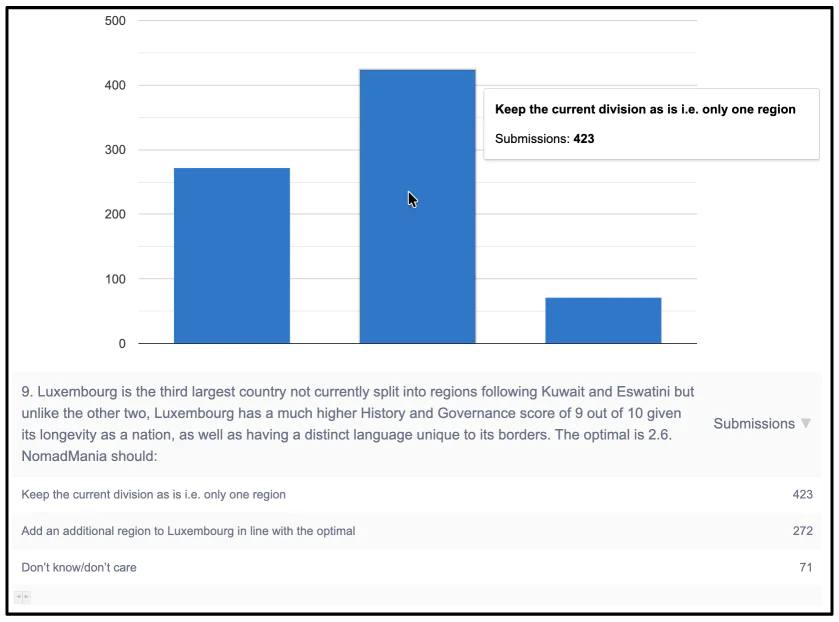
The result becomes even more pronounced at 59% to 32% for travellers above the age of 55.
Surprisingly for us, the proposed addition of regions to Belgium were also rejected by the majority, though this vote was closer. Specifically, 46% reject any new regions for Belgium with 37% supporting the addition of 2 new regions. A total of 6% more supported adding one region, either to Flanders or to Wallonia. However, it is clear we do not have a mandate to split Flanders and Wallonia and therefore we will not.
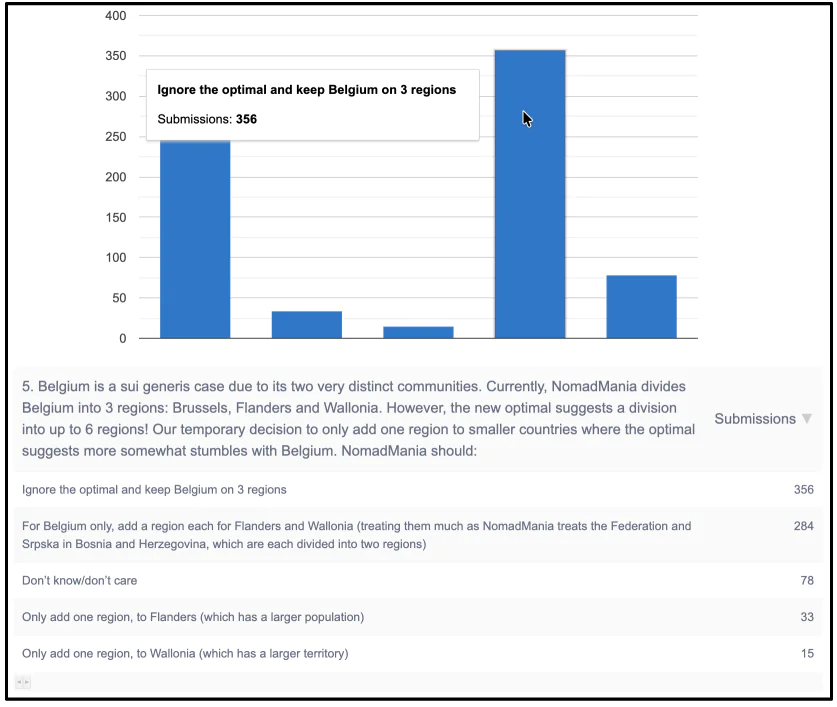
Overall, the results from these polls imply that size really does matter. We will therefore summarily reject any additions to very small countries in this group, with the exception of Albania – see below.
Additions to small countries
Let’s consider ‘small countries’ all countries between 30,000 and 200,000 km2. This is quite a big range but your input has been crucial and decisive here.
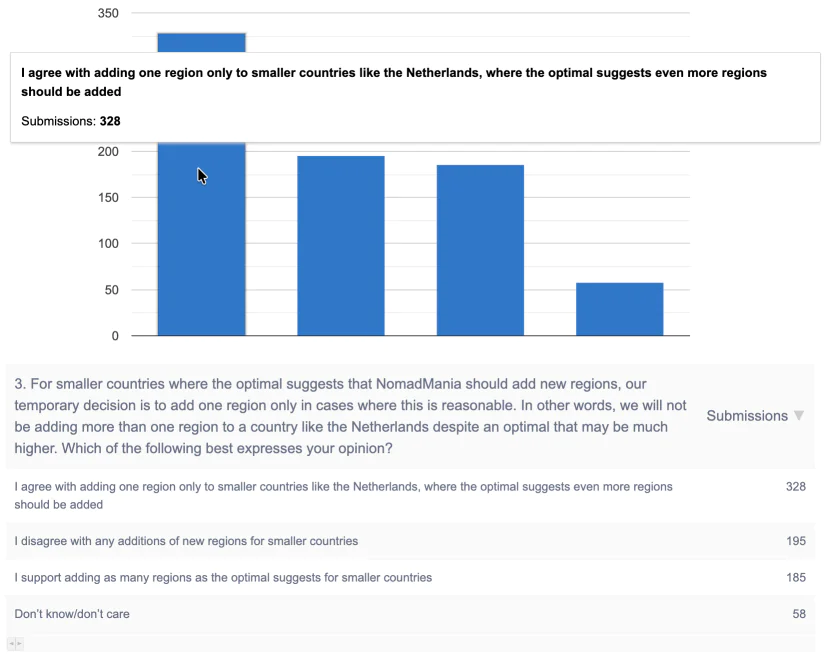
In general, it seems that for small countries (Netherlands was given as an example), the majority are in favour of adding one new region. That would mean that there is a step forward toward the optimal in many cases, however the results reject the addition of more regions to smaller countries if the optimal points to that.
In other words, the optimal is seen as a ‘guide’ rather than as a ‘must follow’.
This idea is also supported by your answers to the first general question of this poll.
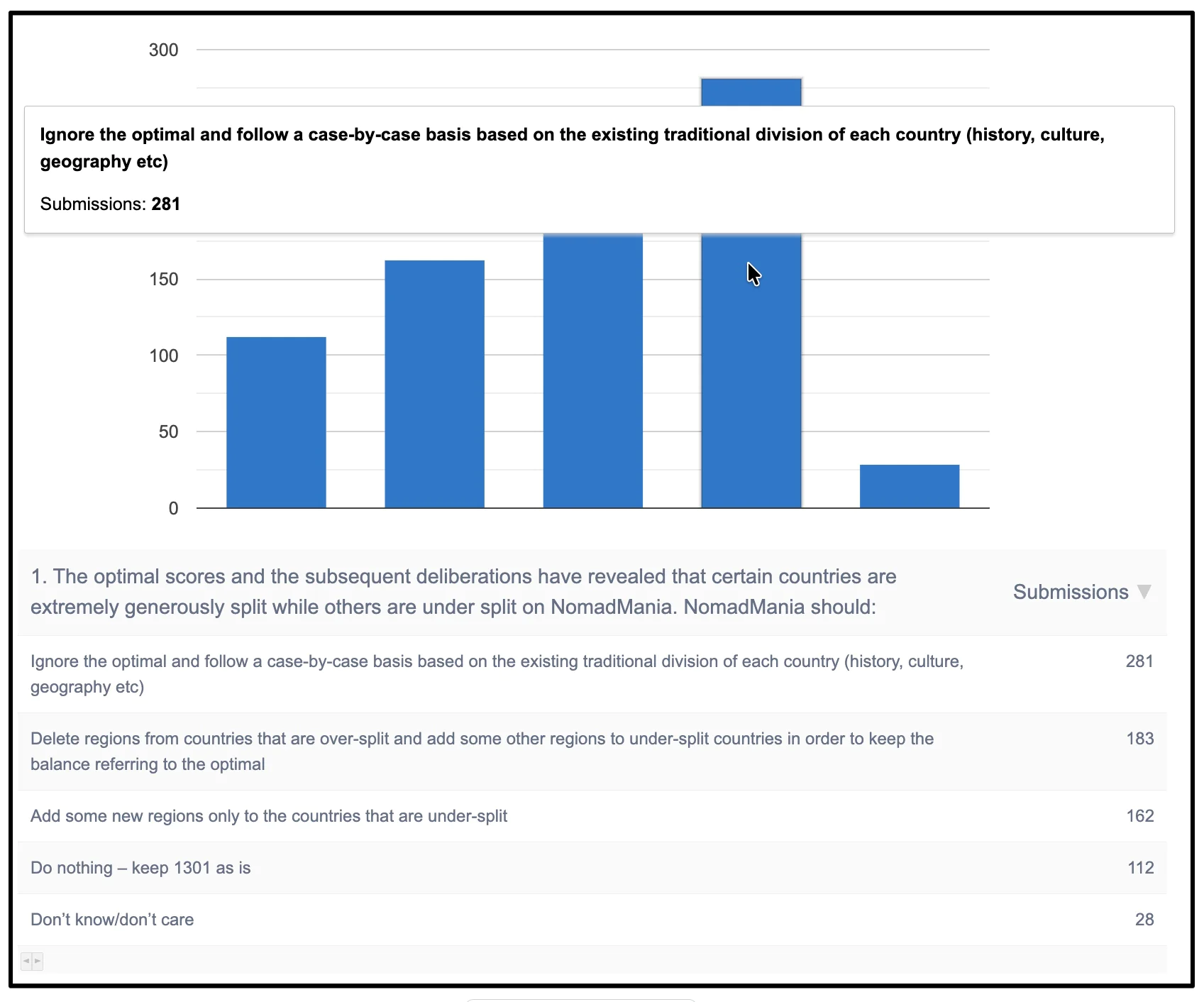
Specifically, 43% support adding one region only to smaller countries. 24% support adding as many regions as the optimal suggests, while 25% reject the addition of any new regions for smaller countries. So, overall, the ‘moderate’ result is the prominent one.
Once again, however, when we analyse based on NomadMania regions visited, travellers with more than 600 regions reject the addition of any regions by 44% and support the addition of one region only by 32%; a further 16% support adding as many regions as the optimal suggests. In other words, while for respondents in general, support for additions in some form is clear – with 68% – for bigger travellers this is only marginal at 48%.
The overall results are corroborated by your vote for Albania and Dominican Republic, which was returned positive to an addition of one more region for each. 59% voted for with only 31% against – the result is an even 50-50 for travellers above 55, while for those under 35 it is 71% for and 19% against; a very big gap based on age.
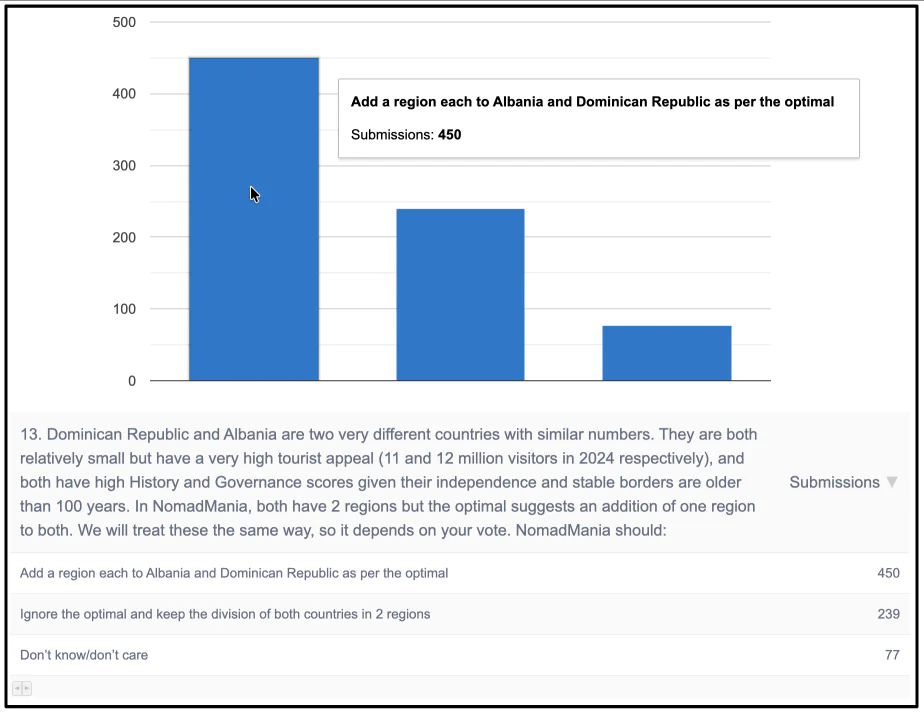
Similarly, for travellers with over 600 regions, 42% are for with 54% against, while for those with under 300 regions, 67% are for and only 21% against.
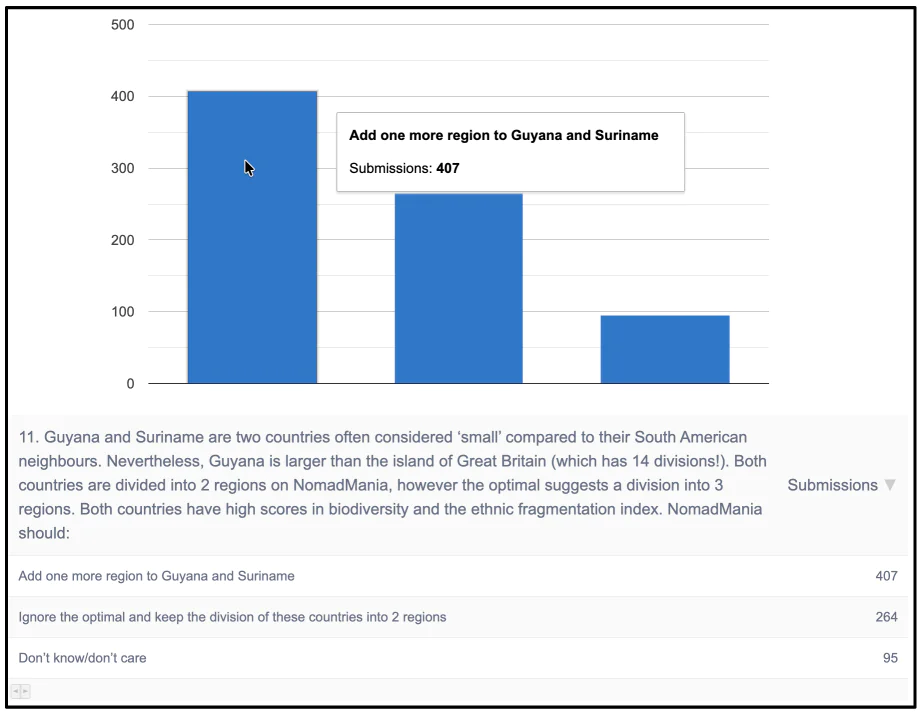
The results for Guyana (which is even larger than 200,000) and Suriname, which are at the upper level of size of this group, once again are positive overall – 53% are in favour of adding an additional region, with 34% against.
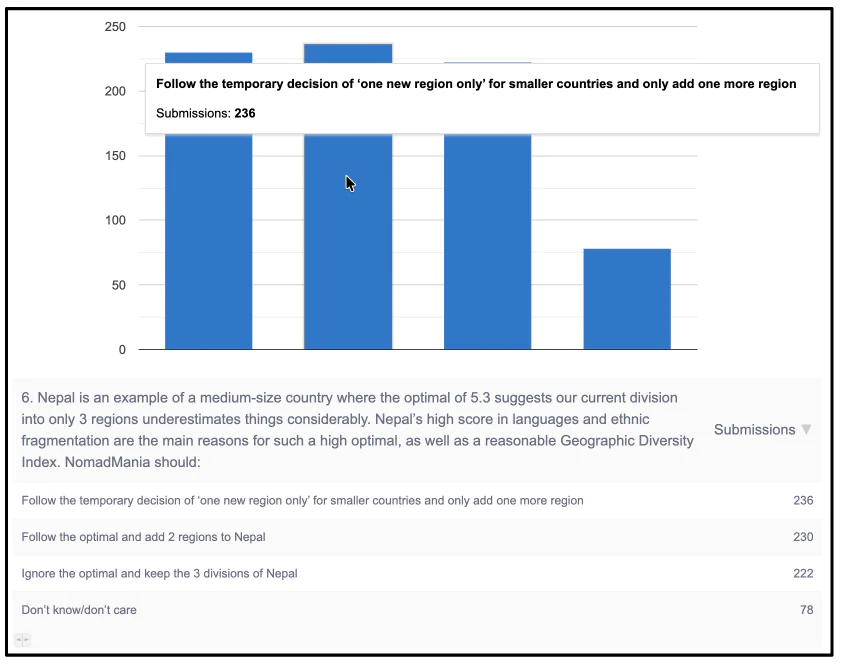
In the case of Nepal, there was a considerable majority in favour of additions – once again, the ‘one region added’ won the vote, but there was also considerable support here for adding the two regions that the optimal points to. Overall, agreeing to some form of addition was 61% of the total (31% supporting one region added and 30% supporting two added), with 29% rejecting any additions.
Which other countries below 200,000 km2 – not asked in the poll – fall under this general category based on the optimal results?
Alphabetically, they are: Austria, Bulgaria, Croatia, Czech Republic, Denmark, Hungary, Portugal, Switzerland in Europe (Greece and Ireland are borderline too) and Bangladesh, Benin, Cambodia, Costa Rica, Panama, Senegal, South Korea, Taiwan and Uruguay globally.
Please see this GUIDE TO REGIONS REVIEW for what YOU could do so we get the additions right.
Additions to larger countries
We have not focused too much on larger countries in our polls so far, but we did ask you about Colombia and Libya to get a first idea of what comes next.
For Colombia, the vote has come back in favour of adding the 2 regions suggested, to approach the optimal (39%), compared to those supporting only one region added (27%) and those against any additions (23%).
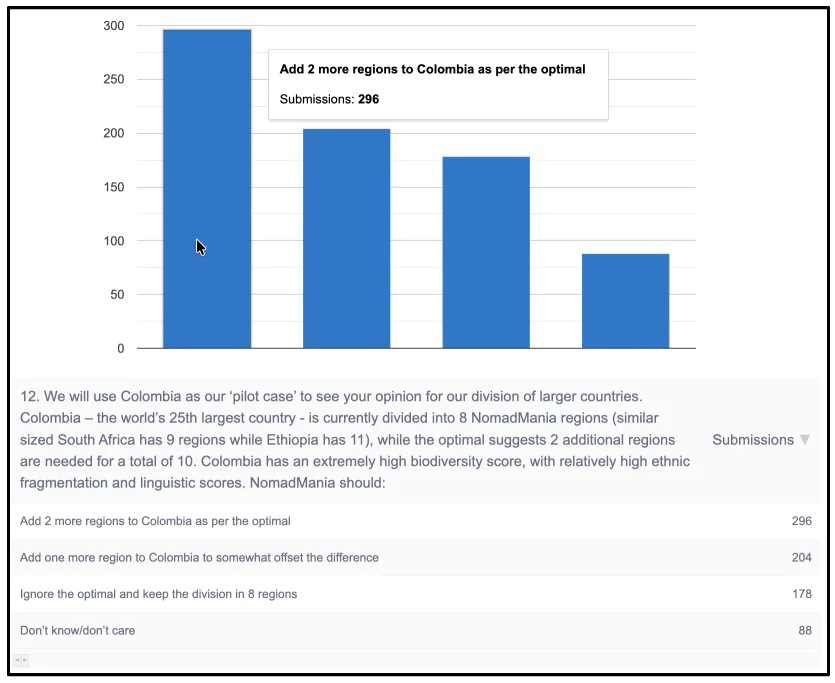
Given this result, we believe that the general impression is that for larger countries, there is a tendency to want to approximate the optimal better.
Even for Libya, which we know is quite an ‘unpopular’ country generally, the results were mixed (45% for and 42% against) but ultimately with a small margin, there was agreement to add a region, which was surprising to us but also points to a general respect for the optimal where this is very clear even in the case of the most ‘cumbersome’ places.
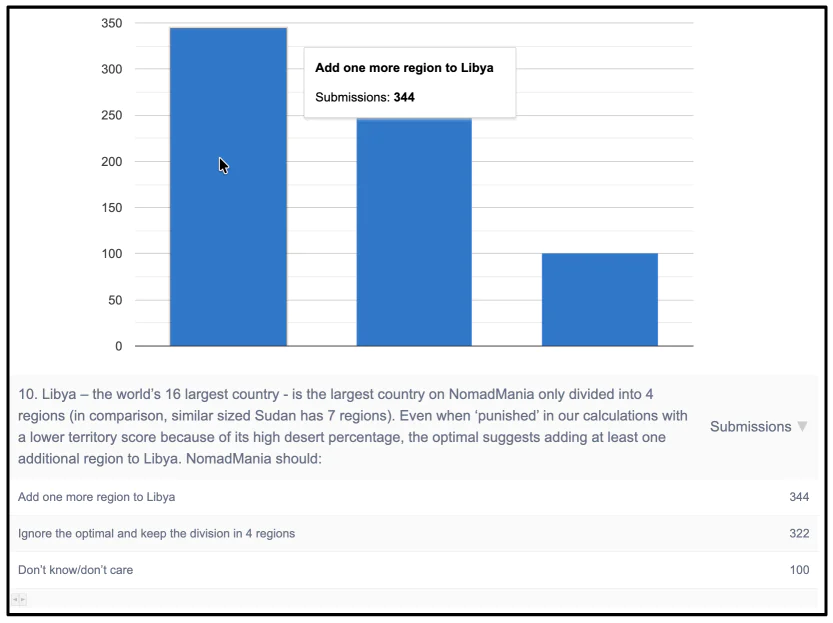
Generally, both these results suggest that for larger countries, we should be attempting a closer approximation of the optimal. We are likely to ask more specific questions in a third poll which will come after the question of the smaller countries has been finalised.
Deletion of regions
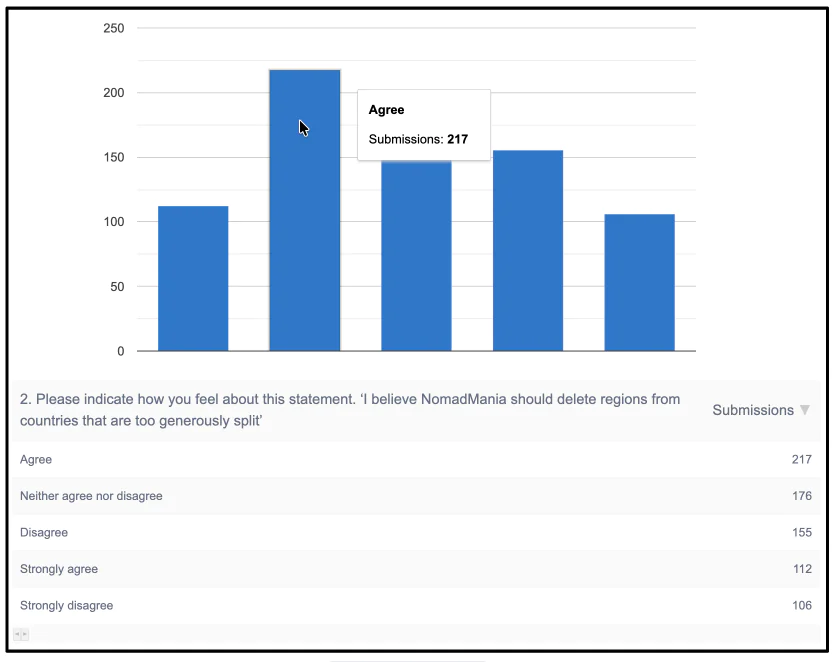
Here is the big shocker. The community supports deleting regions when the optimal indicates it. The numbers are not extremely decisive, as there is also considerable resistance to the idea as well.
Overall, 43% agree with deleting regions (of which 15% strongly) while 34% disagree (of which 14% strongly).
Before we proceed, let us see which countries are truly over-split – we will not list Bosnia and Herzegovina or Micronesia, where the ‘over-splitting’ was conscious because these are seen as ‘sui generis’ cases, or those with an over-splitting that is not so problematic, such as Poland, Namibia, Romania or Yemen. The 70 regions of the US do not include its five territories which are considered ‘essential’.
| Argentina – 25 regions vs. Optimal of 11.51 | Mexico – 25 regions vs Optimal of 18.6 |
| Brazil – 37 regions vs Optimal of 28.1 | Russia – 90 regions vs Optimal of 38.74 |
| Germany – 20 regions vs Optimal of 15.17 | UAE – 7 regions vs Optimal of 4.17 |
| Italy – 21 regions vs Optimal of 16.05 | Ukraine – 8 regions vs Optimal of 4.41 |
| Kazakhstan – 14 regions vs Optimal of 7.58 | USA – 70 regions vs Optimal of 50.0 |
.
The good news: Only 10 of the 193 countries are severely over-split, so we did get it closer for the rest. More good news: some of the above numbers (Brazil, Germany, Italy, Mexico) are not all that bad and are for countries that are very popular with visitors and where each region has a lot to offer the traveller.
The bad news: Some of these countries, especially Argentina and Russia, are getting twice the divisions that they should based on the criteria used for the optimal.
Further complicating the matter is the fact that there is significant disagreement within the NomadMania team regarding this possibility. Overall, however, the sentiment is that a proposal facing a disapproval rate as high as 34% on such an important issue warrants particularly careful examination before any changes are implemented.
Megacities
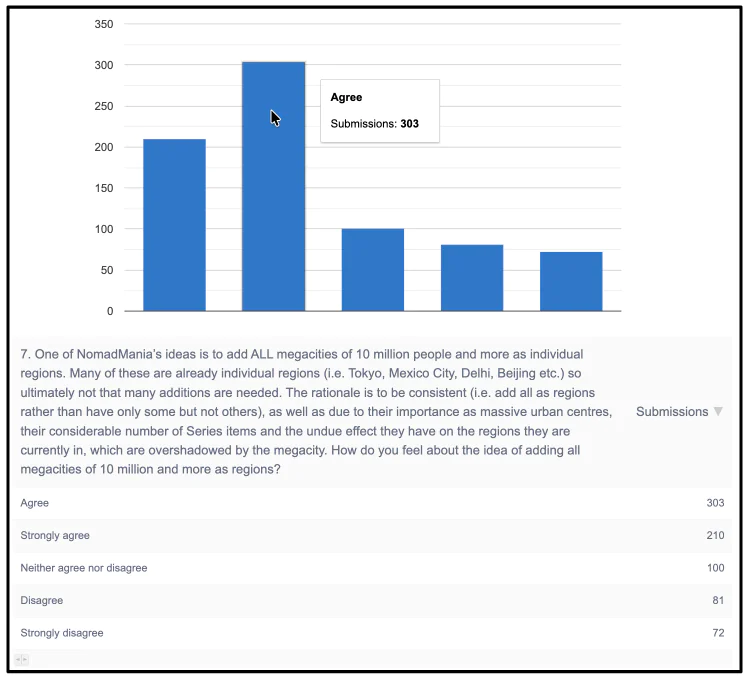
One of our main questions was the idea of adding megacities as standalone regions. This idea was broadly accepted in the poll, with the ‘agree’ and ‘strongly agree’ camps being the two most popular answers with the highest margins of our poll, at 67%, of which 28% strongly. Only 20% disagree with this idea.
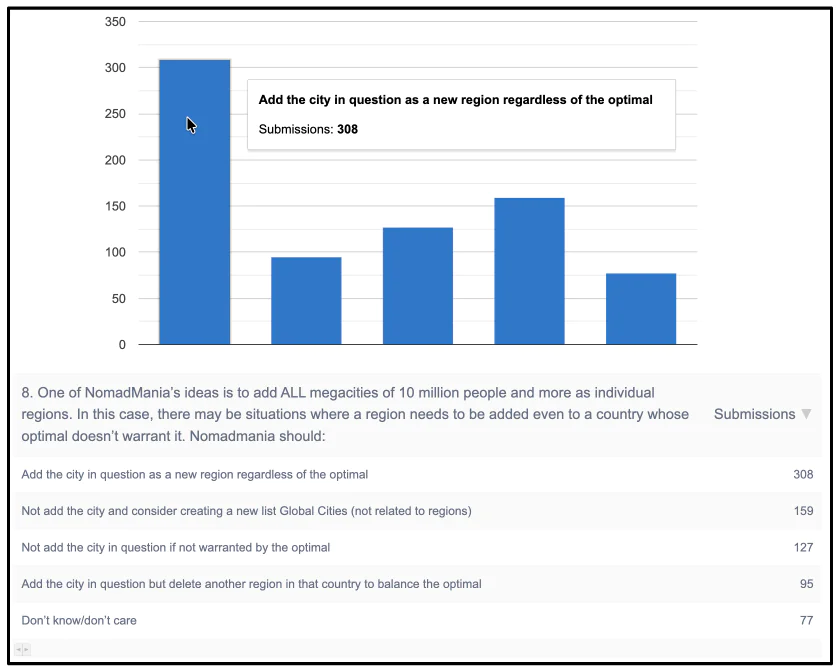
In the question whether the optimal should be overruled if a country has a megacity, this was accepted by the majority as well with 40%.
So that we can be clear about what we mean by megacities, we are hereby attaching a list of cities which could be considered megacities. There are numerous definitional issues here, as well as problems in how the population of a city is calculated by different organisations and what the overall city area is defined as.
We use the following as our sources: https://en.wikipedia.org/wiki/Megacity
– as well as: https://en.wikipedia.org/wiki/List_of_largest_cities
The table below summarises megacities – to the left are those that are currently NomadMania regions and to the right those that are not.
| Country | Megacity – NomadMania region | Country | Megacity – not NomadMania region |
| Argentina | Buenos Aires | Angola | Luanda |
| Brazil | Rio de Janeiro | Bangladesh | Dhaka |
| Brazil | Sao Paulo | China | Chengdu |
| China | Beijing | China | Chongqing (city versus rural) |
| China | Guangzhou | China | Wuhan |
| China | Shanghai | China | Xi’an |
| China | Shenzhen | China | Zhengzhou |
| DR Congo | Kinshasa | Colombia | Bogota |
| Egypt | Cairo | India | Bangalore |
| France | Paris (as Ile de France) | India | Chennai |
| India | Delhi | India | Hyderabad |
| Indonesia | Jakarta | India | Kolkata |
| Iran | Tehran | India | Mumbai |
| Japan | Tokyo | Japan | Osaka |
| Korea | Seoul | Pakistan | Lahore |
| Mexico | Mexico City | Taiwan | Taipei |
| Nigeria | Lagos | USA | Los Angeles |
| Pakistan | Karachi | Vietnam | Ho Chi Minh |
| Peru | Lima | ||
| Philippines | Manila | ||
| Russia | Moscow | ||
| Thailand | Bangkok | ||
| UK | London | ||
| USA | New York City |
.
Additional cities that are growing in population and importance are: Ahmedabad, Alexandria, Bandung, Changsha, Dar es Salaam, Hangzhou, Johannesburg, Kuala Lumpur, Nagoya, Riyadh, Surabaya and Xiamen.
POLL 1
It included 10 questions and had two dimensions – some general, and then some very specific. What is interesting here is that the specific resulted in more homogeneity and clarity in the answers. The general ones … oh boy. The NomadMania community is seriously divided. Both by age and by number of visited regions…
Let us start with where people more or less agreed
The percentages not listed are rather high values of Don’t Know/Don’t Care responses.
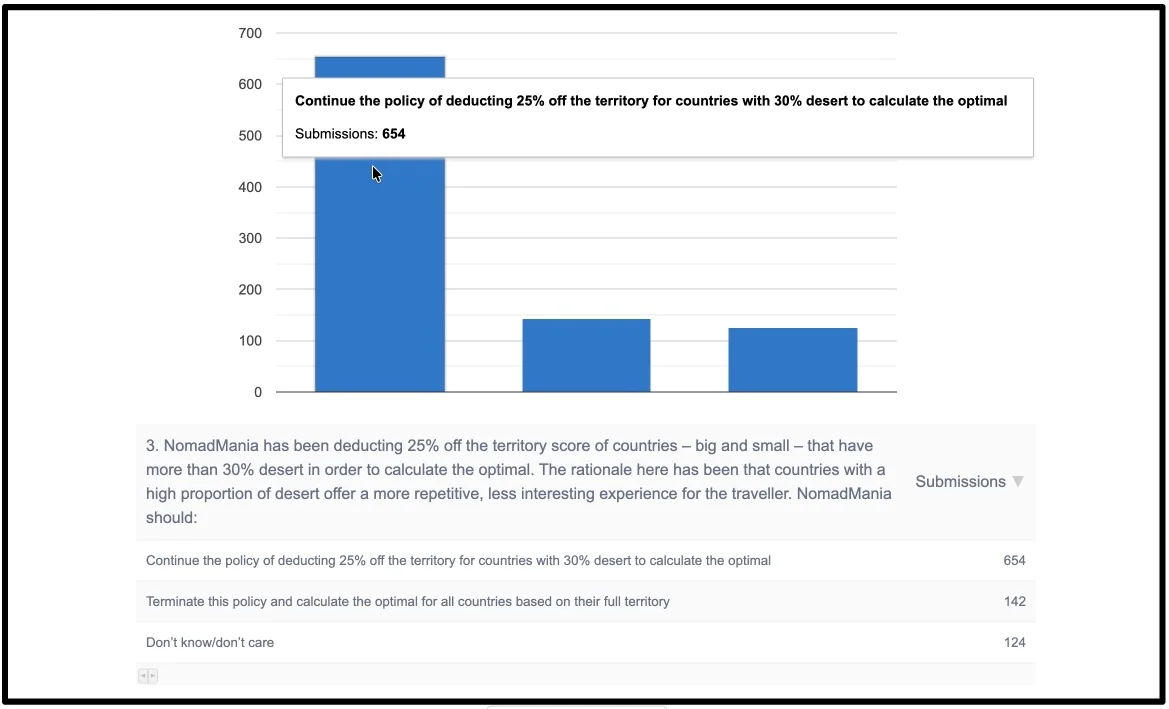
70% agree that we should continue our policy of deducting 25% of the territory of countries that have more than 30% desert; only 15% disagree with this.
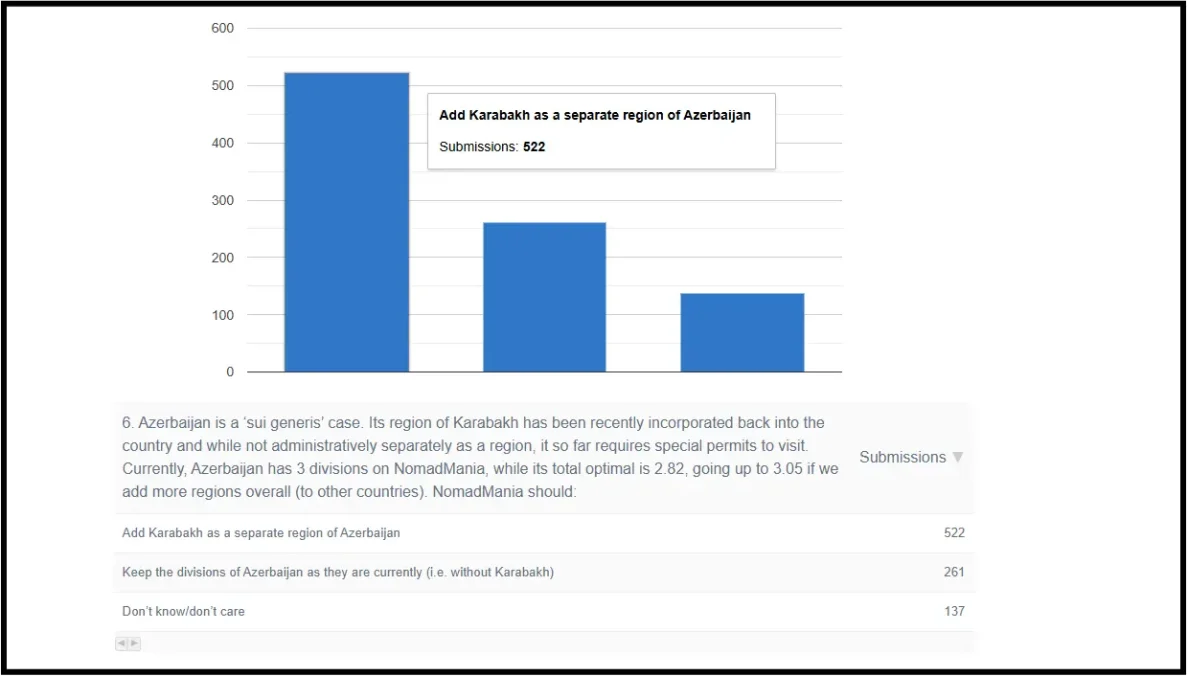
In terms of the possible addition of Karabakh as an extra region of Azerbaijan, 58% agree whereas only 27% disagree.
In terms of adding the Kurdish controlled region of North-East Syria as a region, a total of 55% is in favour, with only 26% against – the most popular answer here was to add this as a 4th region to Syria which was chosen by 35% of respondents.
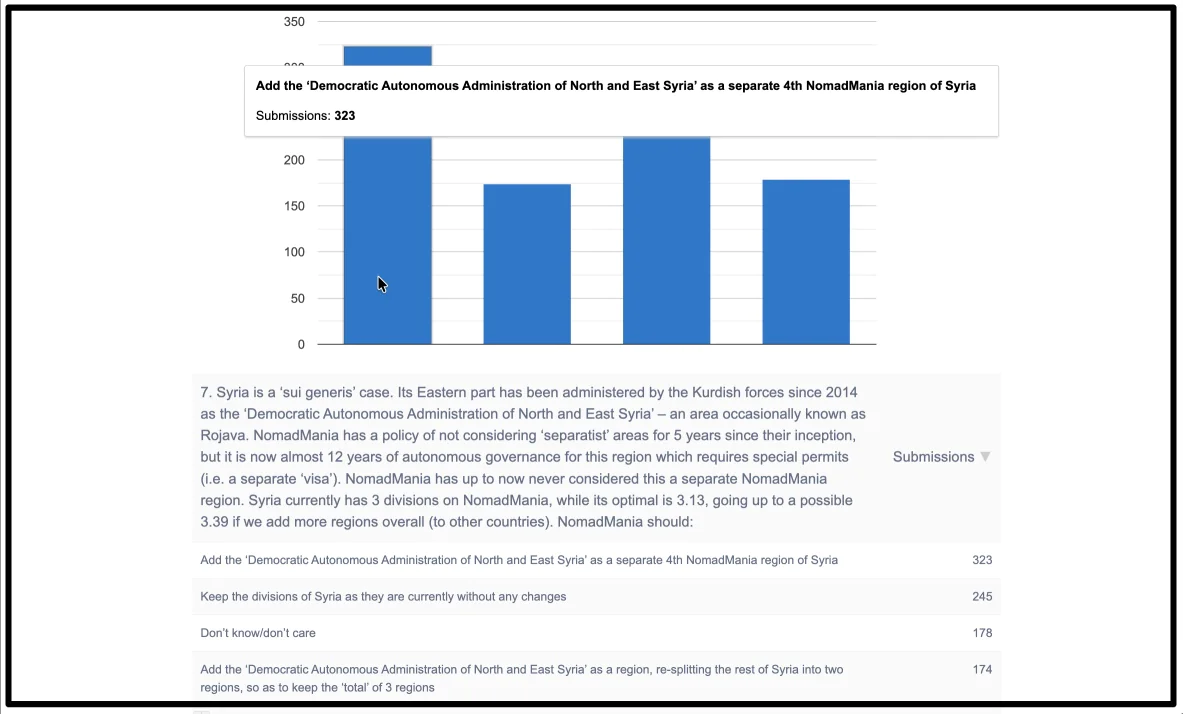
The biggest agreement was in terms of Antarctica where a massive 82% does not want any new regions and is happy with our current division – less than 6% suggested further regions for the icy continent.

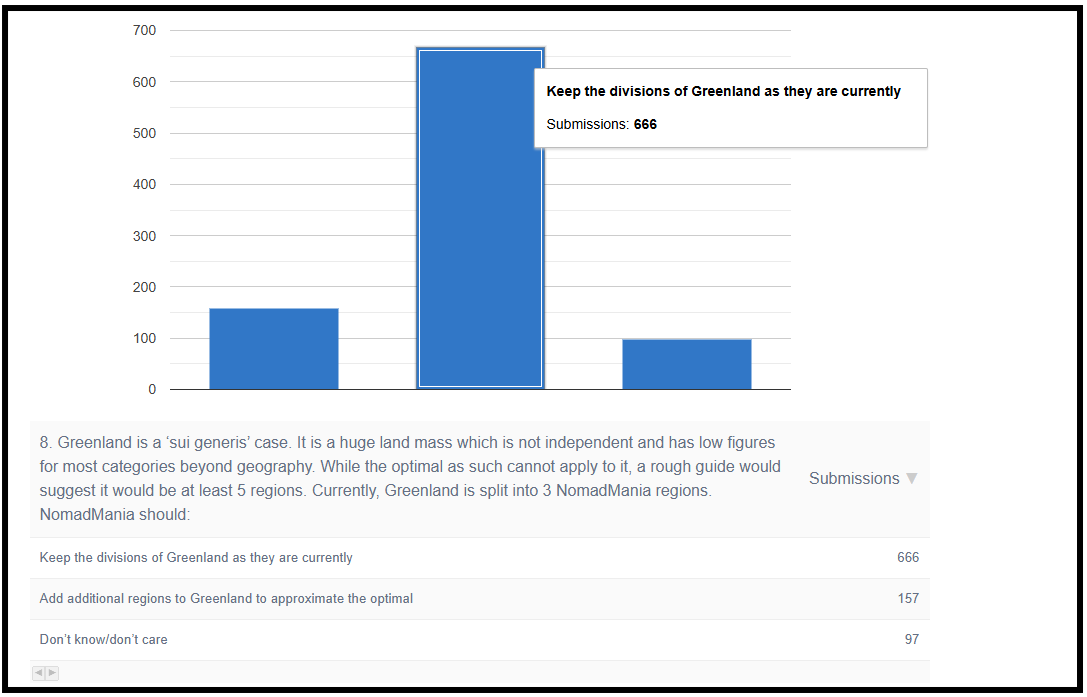
Similarly, 72% of respondents are happy with the 3 NomadMania regions in Greenland, while only 17% expressed support for the addition of more regions.
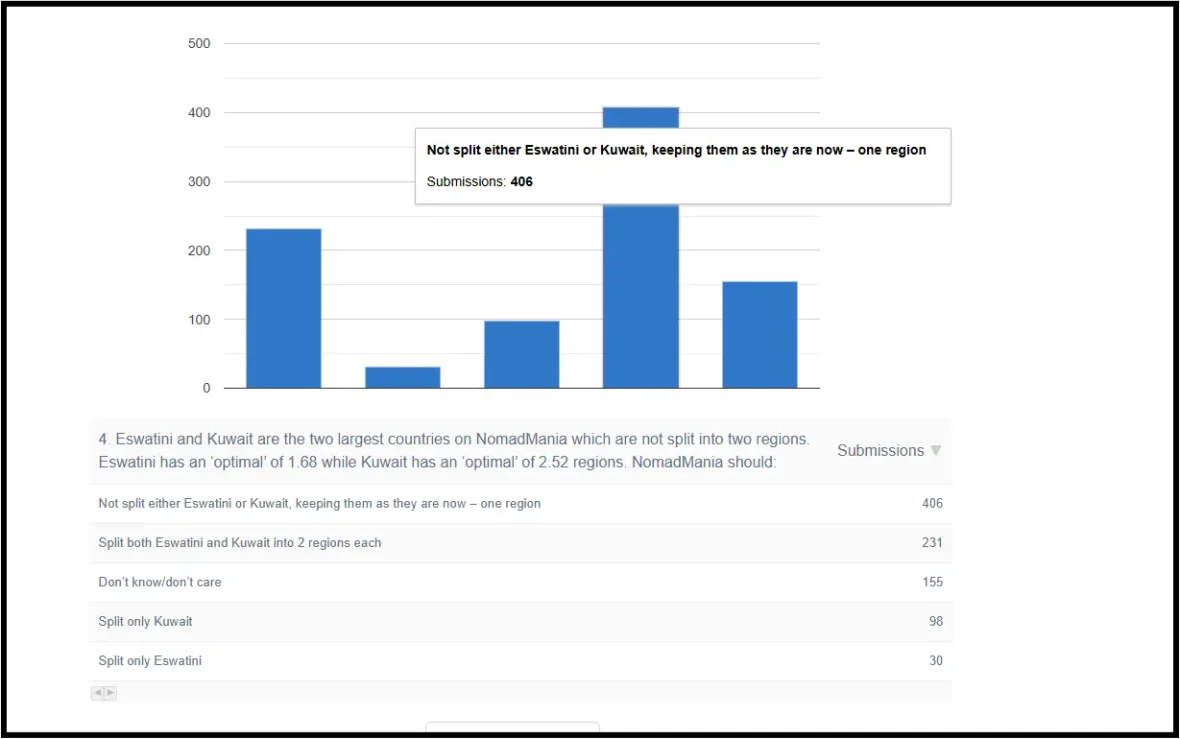
Answers were more mixed regarding Puerto Rico and the question of the two largest countries which we do not split, Eswatini and Kuwait. Regarding the former, only 7 votes separate the percentages of support for an additional region in Puerto Rico (43.9%) versus keeping it as one region (43.1%).

In terms of Eswatini and Kuwait, 44% reject a split into further regions. 36% support splitting Kuwait in total, whereas only 28% support a split of Eswatini.
Please note all these votes are consultative, however in the cases where there are convincing majorities, we are inclined to follow popular opinion unless there is very good reason not to.
The more interesting issues are the more important ones too
These relate especially to two questions, which essentially asked for the general feelings of our community about adding new regions.
In the first question “The Optimal Score for Regions has shown that some countries are seriously under-split in terms of divisions on the NomadMania Masterlist” we generally offered three possible responses.
The total results are as follows:
- 44.9% – follow optimal case by case
- 23.5% – follow optimal closely
- 23.6% – ignore optimal
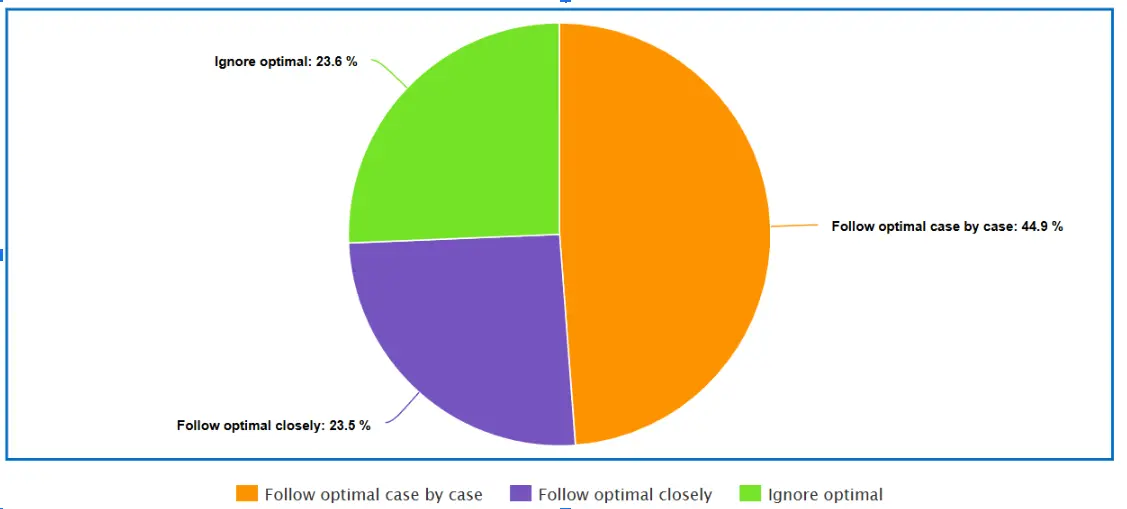
As you can see, the last two options are almost tied (1 vote difference), but this is where things get more complex if we analyse by age of respondents and by number of regions visited further classified in age group :
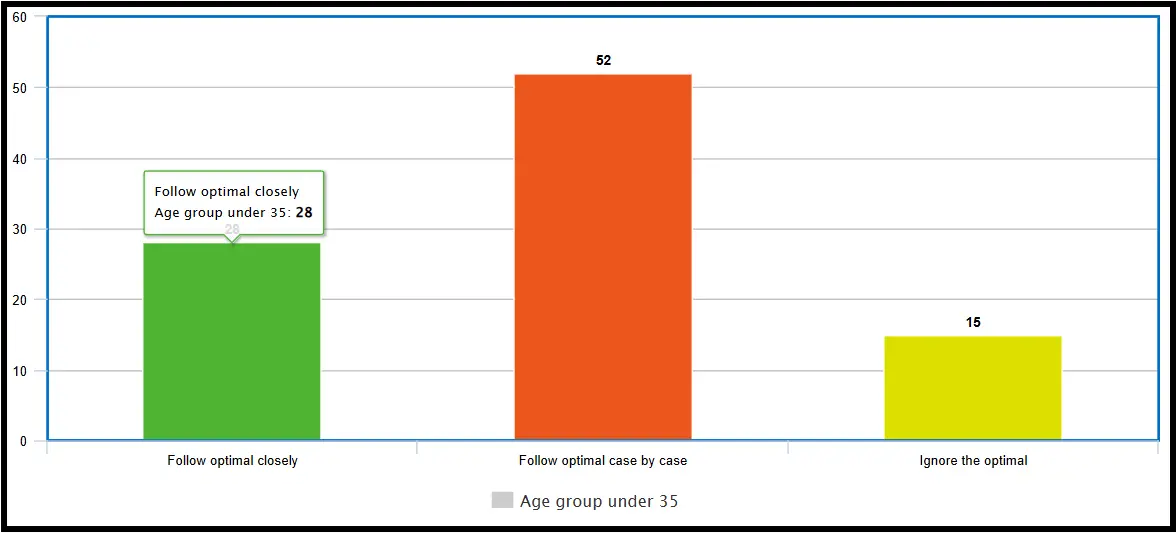
For travellers under the age of 35, 52% opt for the case-by-case option, followed by 28% who prefer us to follow the optimal closely, while only 15% want us to ignore the optimal.
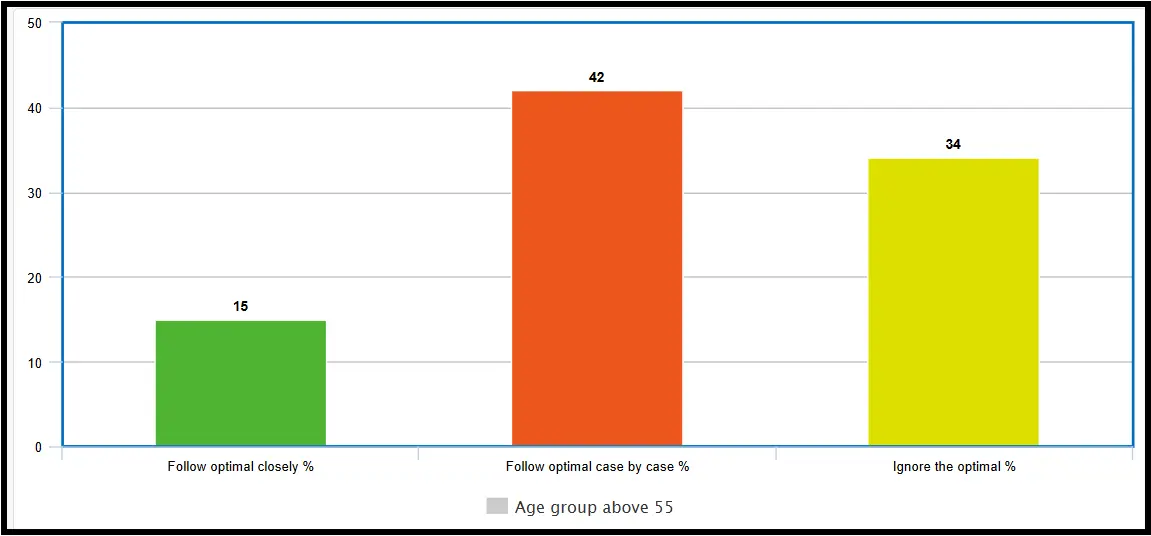
However, for travellers over the age of 55, 42% opt for the case-by-case option, followed by a desire to ignore the optimal by 34% and only 15% want us to follow the optimal closely.
This pattern repeats itself if we look at the data based on how many regions respondents have been to. For travellers with less than 150 NomadMania regions, 46% want us to follow the case-by-case option, 31% want us to follow the optimal closely while only 15% reject the optimal.

However, for the other extreme, for travellers with more than 600 regions, 56% want us to entirely ignore the optimal (i.e. not add any regions), and less than 10% want us to follow the optimal closely.
Despite a much smaller sample size (66 respondents with over 600 regions total), we can most certainly reach the conclusion that older and more experienced travellers are much more likely to ignore the idea of adding more regions compared to younger ones who give the optimal 80% support in total, either case-by-case or following it diligently. These numbers explode even more when analysed by number of regions visited, where support for the project of adding regions seems to collapse completely for those at the top of the rankings.
The statistical variance is repeated for the questions regarding possible additions of regions to smaller countries, though in general the conclusions are that all travellers are hesitant to follow the optimal too closely if a country is small.
The general results here were – 53% ignore the optimal, 39% follow it.
While the ignore/follow divide is almost 50-50 for travellers with less than 150 regions, in those above 600, 63% opt for ignoring the optimal.
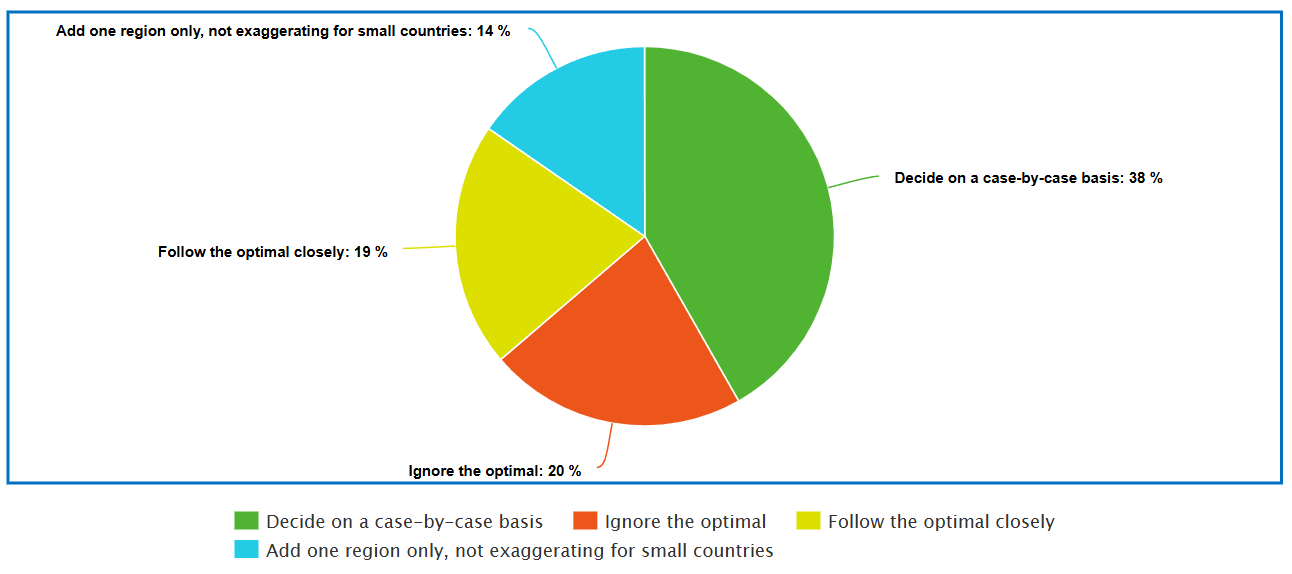
When given more choices, respondents chose the following:
- 38% – decide on a case-by-case basis
- 20% – ignore the optimal
- 19% – follow the optimal closely
- 14% – add one region only, not exaggerating for small countries
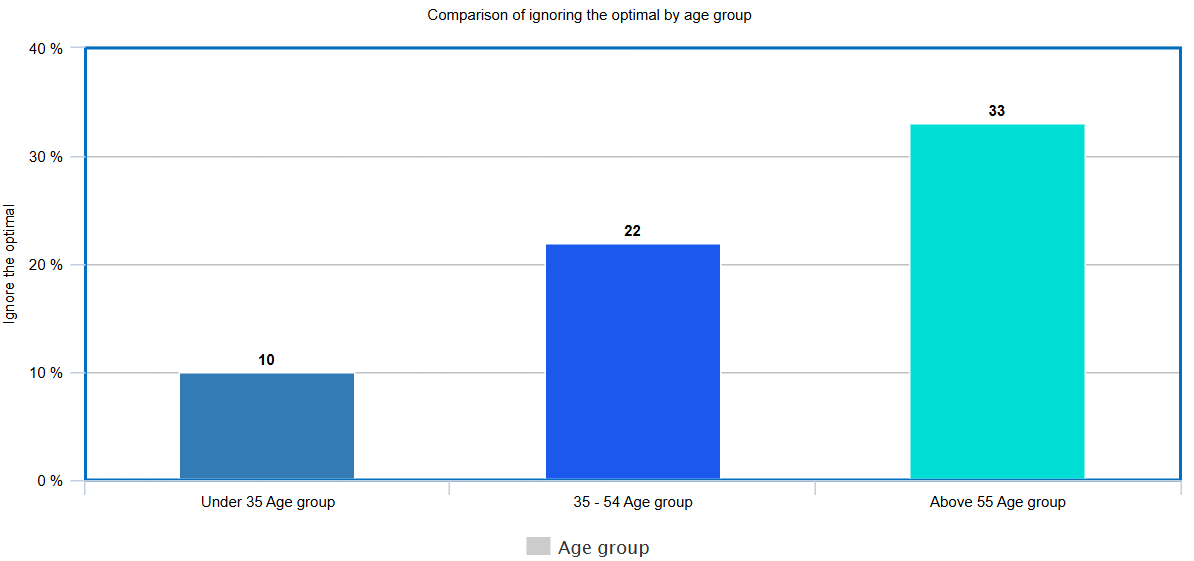
Once again in these last results, we see a similar trend by age and number of regions. 33% of older travellers want us to ignore the optimal compared to only 10% of the younger ones under 35 (the 35-54 group is in the middle, with 22% rejecting the optimal).
And while only 10% of ‘intense’ travellers want us to follow the optimal closely, with 47% ignoring the optimal, in the less experienced travellers only 10% want to ignore the optimal.
Conclusions?
A slightly philosophical question – who does NomadMania want to serve?
Do we want to be a platform for the very ‘intense’ travellers or rather for everybody with an interest in travel beyond the obvious? Do we want to look at the older, ‘experienced’ traveller and follow their vote, or do we want to look more toward the younger, less travelled (so far)? The severe differences in the percentages observed have us wondering why – is it that the travellers who have done so much are tired and don’t want to do more? Is it that the younger ones may trust the data more perhaps because they feel they don’t have the travel experience?
We cannot interpret the results accurately nor is this our purpose – our main aim is to reach sound decisions which are both fact-based and generally serve our community – divided as it may be.
What we may well conclude is that Azerbaijan and Syria will likely be the first countries to receive an additional region once we start this process in 2026 – and this is following your vote and a clear margin of support for this overall. We can also permanently ‘freeze’ any ideas of additions to Antarctica or Greenland based on the very clear ‘no’ vote.
We can also conclude that, in general, for small countries we will take a much more cautious approach and not follow the optimal ‘blindly’ where this will lead to absurd results, while at the same time not totally ignoring it – case-by-case, vote-by-vote may be called for especially for the smaller countries – so we ask for your to enthusiastically share your opinion when we ask for it (we may limit the ‘don’t know’ options).
Somewhat encouragingly though, less than a quarter of respondents reject the Optimal overall, with two-thirds broadly accepting it, and therefore this will be our main guide in terms of reviewing regions.
Overall, for many of the questions, we will come back to you, the NomadMania community.